

Social media marketing services measured in pipeline,
not in posts.
Most companies do not have a posting problem. They have a demand problem that posting was never going to fix. Biz Klinics works as a social media growth consultant — building audience, engagement and inbound leads as one accountable system across organic and paid social.
Stop buying posts. Start owning an audience.
social media user identities in India
of India's digital ad spend now goes to social
average Instagram engagement rate by followers
The problem with the categoryA content calendar is a deliverable.
It was never a strategy.
Ask most social media marketing companies what they sell, and the honest answer is a quantity: twelve static posts, four reels, eight stories, one monthly report. The calendar is the product. Whether any of it moved the business is treated as somebody else’s question.
That model made sense when distribution was cheap. It is not cheap any more. Socialinsider’s 2026 benchmark study, drawn from an analysis of 70 million posts, puts average Instagram engagement by followers at roughly 0.45% and Facebook at around 0.17% — with engagement declining across most major platforms year on year as feeds get more crowded and brands publish more than ever.
Volume no longer buys attention. Publishing five posts a week into an algorithm that shows them to a fraction of your own followers is not a growth plan; it is a subscription to activity.
Meanwhile the money has moved. dentsu’s 2026 report puts Indian digital advertising at ₹71,621 crore in 2025 — 59% of all advertising spend — with social media taking the single largest slice of digital at 29%.
Your competitors are not under-spending on social. They are spending heavily on it and, in most categories we walk into, they are spending it on the same three things: boosted posts, follower campaigns, and a lead form nobody follows up on inside an hour.
“We have 40,000 followers and no enquiries. Our reels get views from cities we don’t sell in. Our agency’s report is full of impressions and our sales team’s calendar is empty.”
What we are actually hired to doThree jobs. One scoreboard.
As a social media consultant for business growth, we hold three outcomes — and each one has a number attached that a founder can read in ten seconds. Follower count is not one of them.
Audience building
Not audience size — audience composition. Ten thousand followers who cannot buy from you is a liability: it inflates your denominator, depresses your engagement rate, and teaches the algorithm to serve you to more of the wrong people. We build audience against your defined ICP and your actual serviceable geography, which usually means growing slower on purpose in month one and compounding faster from month four.
Engagement
Engagement is not applause. It is evidence that the message landed with someone who has a problem you solve. Socialinsider's data shows comments per post falling on both Instagram and TikTok while shares rise — audiences are moving from public conversation to private forwarding. So we optimise for the signals that predict revenue, not the vanity of a like count.
Inbound leads
The point. Every content pillar is built with a conversion path attached before it is shot — a DM keyword, a WhatsApp trigger, a landing page, a calendar link. Leads are qualified against the same ICP definition, routed into your CRM, and traced to closed revenue rather than counted at the form. If a pillar produces reach but never a conversation, it gets cut.
The core modelOrganic + Paid Social Growth
Organic social is an owned asset that compounds. Paid social is rented demand that stops the day you stop paying. Run separately, they each waste the other. Run as one loop, each makes the other cheaper.
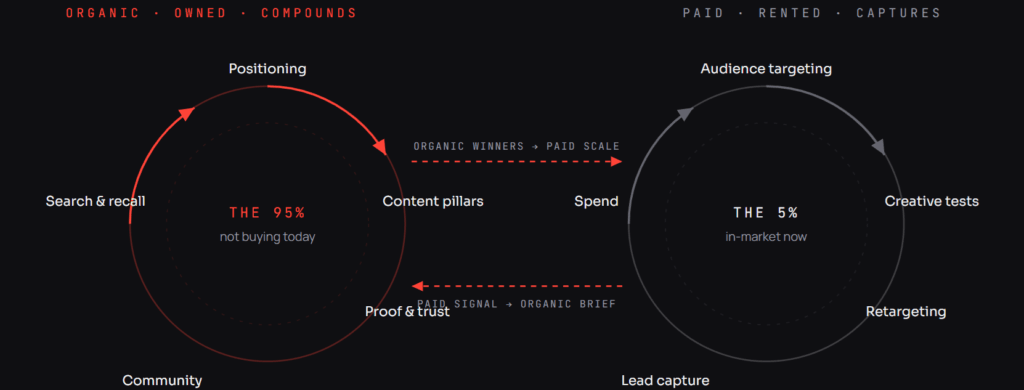
The logic underneath the diagram is not ours — it is Professor John Dawes’ work at the Ehrenberg-Bass Institute for the LinkedIn B2B Institute, now widely known as the 95:5 rule. At any given moment, roughly 5% of your potential buyers are actively in the market. The other 95% will buy at some point over the next several years, and when they do, they overwhelmingly shortlist brands they already recognise. Gartner’s research reinforces the same shape from the other side: a typical B2B buying group runs to six to ten decision-makers, and when comparing suppliers they may spend as little as 5–6% of their time with any single sales rep. Almost the entire decision is formed before anyone calls you.
This is why “just run ads” and “just post organically” are both wrong answers. Paid alone competes for the same 5% every competitor is bidding on, at a price that rises every quarter, and buys you nothing the day you pause. Organic alone builds memory with the 95% but reaches them so slowly that a founder loses patience by month four. The four handshake points are where the money is:
Organic as the creative testing lab
We never spend meaningfully behind an untested concept. Organic tells us which hooks, formats and proof points earn saves before a rupee is committed to distribution.
Paid as the distribution layer for proven work
The film that performed organically gets budget. This is how a well-produced asset reaches many times its organic audience instead of dying in the feed at day three.
Paid signal as the organic brief
Ad-level data tells you which objection actually blocks the sale. That objection becomes next month's organic pillar — for free.
Organic audiences as the retargeting pool
Video viewers, profile visitors and engagers become custom audiences. Retargeting warm organic audiences is consistently the cheapest qualified lead in the account.
The difference in the roomSMM agency vs. social media growth consultant
Both produce posts. Only one of them is answerable for what the posts were supposed to achieve.
| DIMENSION | TYPICAL SOCIAL MEDIA MARKETING COMPANY | BIZ KLINICS |
|---|---|---|
What you buy |
Output — a fixed number of posts, reels and stories per month |
A system — positioning, content architecture, distribution and a conversion path |
Where it starts |
A content calendar in week one |
A diagnosis: who buys, why they choose, and where demand currently leaks |
Success metric |
Reach, impressions, follower count, engagement rate |
Qualified enquiries, cost per qualified enquiry, pipeline value, closed revenue |
Organic & paid |
Two teams, two reports, boosted posts as an afterthought |
One loop — organic tests, paid scales, paid data briefs organic |
When leads arrive |
Forwarded to the client in a spreadsheet |
Qualified, routed to CRM, followed up inside the hour, traced to close |
Where it ends |
At delivery of the asset |
At the number it was engaged to move |
What you keep |
Files and logins |
The reasoning, the playbooks and a team that can run them |
Find out what your social media is actually producing.
A free 30-minute Growth Diagnosis with a senior growth consultant. We look at your audience composition, your content-to-conversion path and where enquiries are currently leaking. You leave with three prioritised fixes and an honest read on whether we are the right partner. No deck. No pitch.
Frequently asked questions
How is a social media growth consultant different from an SMM marketing agency?
An SMM marketing agency is contracted to produce output — a defined number of posts, reels and stories, delivered to a calendar. A social media growth consultant is contracted to move a business number. In practice that changes four things: we start with a diagnosis rather than a calendar, we define the audience by who can actually buy rather than who will follow, we run organic and paid as one loop instead of two invoices, and we report against qualified enquiries and pipeline rather than impressions. You can still buy execution from us. You cannot buy it without the strategy that makes it work.
Do you handle both organic content and paid social campaigns?
Yes, and deliberately as one system rather than two services. Organic is where creative is tested cheaply and where brand memory is built with the roughly 95% of buyers who are not in the market this quarter. Paid is where proven creative gets distribution and where the 5% currently shopping are captured. The handshakes between them — organic winners becoming paid creative, ad data briefing next month’s organic pillars, organic engagers becoming retargeting audiences — are where most of the efficiency comes from, and they are exactly what gets lost when the two are bought from different vendors.
How long before social media produces real business results?
Paid social can produce qualified conversations within four to eight weeks, depending on your category, your offer and how ready your sales follow-up is. Organic audience building and brand recall compound over two to three quarters — that is the nature of the asset, and any social media marketing company promising otherwise is selling you the 5% and calling it growth. What you should expect immediately is clarity: a defined ICP, a working conversion path, honest tracking, and a weekly view of what is being tested.
We already have an in-house team posting daily. What would you actually add?
Usually direction rather than volume. In-house teams are typically excellent at execution and starved of the bandwidth to step back, redefine the audience, rebuild the content architecture and instrument the conversion path while still shipping daily. We operate as the strategic growth layer above your team — providing the positioning, the pillar architecture, the paid model and the measurement discipline. Most in-house teams get noticeably more effective once they are executing against a validated strategy instead of guessing at one.
Which platforms do you recommend, and do we need to be on all of them?
Almost certainly not. Platform choice follows the buyer, not the trend. In India, YouTube and Instagram carry the largest audiences and WhatsApp carries most of the actual conversation, while LinkedIn — with roughly 170 million registered members in India per LinkedIn’s own advertising data — matters disproportionately for B2B, specification-led and high-ticket categories. For a luxury furniture retailer that mix looks nothing like it does for a B2B SaaS firm. We would rather you be genuinely strong on two platforms than visibly thin on five.